November 2025
Nominations for the CSD-N Board of Directors have closed. One new candidate, Stephen Mathewson, has volunteered to run. Two current Board members, Sarah Hazelwood and Peter Mansbach, are running for re-election.
Since there are three candidates for three slots on the Board, it is not necessary to conduct formal balloting by the membership.
New Board members begin to serve at the start of the next meeting, on Jan 15, 2026.

October 2025
CSD-N Board members Sarah Hazelwood and Andrew Cowen recently met with representatives of the Society of Behavioral Sleep Medicine (SBSM). The working group was composed of medical providers, researchers, and a number of individuals living with Circadian Rhythm Disorders. Those with CRDs shared thoughts on their experiences living with these conditions as well as navigating medical care. The group discussed how to prioritize outcomes for sleep interventions. The volunteers weighed in with the medical providers about their priorities and concerns with their sleep disorders, and what each might consider as ideal outcomes when working with medical professionals.

October 2025
Naomi Mittet, former CSD-N secretary and board member, was interviewed for an article in SeattleMet, What It's Like to Truly Be Sleepless in Seattle - Life with a circadian rhythm sleep disorder, by Haley Shapley.
Naomi describes her child's struggles with school, and her own gradual realization that Non-24 was behind those struggles. Another interviewee, Tyler Zuck, describes his experience with DSPD.
October 2025
Circadian Sleep Disorders Network will be holding elections for its Board of Directors. Requirements are described here.
Meetings are held by online forum, so you can log in at any time of day (typically once a day) to read what's been posted and post your replies. Meetings do continue for two months or more, though often not very actively.
If you're interested, please let us know soon (latest Nov 15), following the instructions at the end of the above document. Directors start serving January 15, 2026. Terms generally run for two years.
Currently running for re-election to the board are Peter Mansbach, Sarah Hazelwood, and (provisionally) Samuel Bearg.
We are also often looking for other volunteers willing to help. These can be board members but do not have to be. If you're interested in volunteering, please let us know, including any skills you have. In particular, we need a secretary, who may be, but does not need to be, a board member.
Oct 13, 2025
 CSD-N president Peter Mansbach was interviewed by Abigail Myers, a Ph.D. student at the University of Vermont. Ms Myers is a participant in the National Science Foundation's I-Corps (Innovation Corps) program.
She was interested in the problems circadian rhythm sleep disorders patients face, our needs for research, and how that research might translate into practice. She was particularly interested in melatonin. Peter reviewed some of his own experiences, and referred her to our Needed Research document and our survey results publication.
August 2025
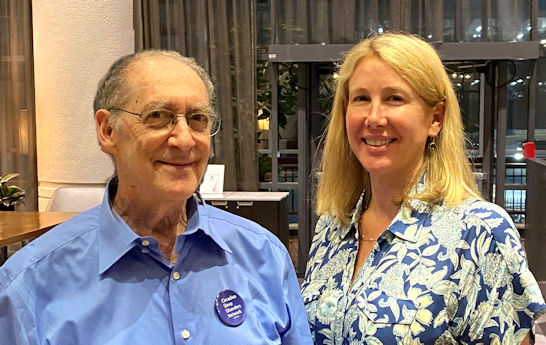
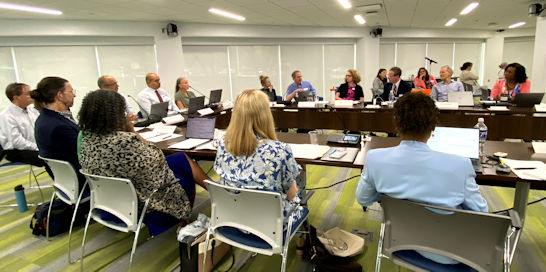
On August 7 and 8, 2025, the NIH (U.S. National Institutes of Health) Sleep Disorders Research Advisory Board (SDRAB) in-person meeting was held in Bethesda. CSD-N Executive Vice President Alex Wharton, our SDRAB representative, attended. CSD-N President Peter Mansbach also attended on the first day.
SDRAB members (sleep physicians, researchers and patient advocates) and attendees shared their perspectives on a range of sleep health matters. Speakers included Dr. Anita Shelgikar, president of the American Academy of Sleep Medicine, Dr. Klar Yaggi, director of Yale Center for Sleep Medicine and Dr. John Hogenesch, president of the Society for Research on Biological Rhythms.
The purpose of the meeting was to make recommendations for refreshing the goals of the NIH Sleep Research Plan, which was last published in 2021. One of the sections of the Research Plan focuses on elucidating sleep and circadian mechanisms that underlie health and disease.
On August 7, Alex spoke about the need for a faster time-to-diagnosis for DSPD. She recommended a detailed patient history that includes family members, testing for biomarkers like melatonin and cortisol and DNA testing for variants of clock genes.
She stressed that there is no silver bullet for treating DSPD. Treatments that are proven to be effective for shifting sleep earlier for some late chronotypes / night owls such as light therapy, phase-delay chronotherapy, SSRIs, CBT or stricter schedules are not effective for DSPD. She hopes that as awareness builds, accommodations for later start times at work and school (and starting all schools later) will become more accepted.
One of the talks called for increased awareness of the impact of sleep health on one's risk of diabetes. Peter noted that his doctor knew about that connection - she told him that "going to bed at 3:30 a.m. is going to increase your risk of diabetes" - but did not understand that individual circadian phase needs to be taken into account. We still need to raise awareness of circadian rhythm disorders and their impacts.
On August 8, Alex spoke about the danger of anticholinergic medications (diphenhydramine, some antidepressants such as Trazodone and hypnotics such as Ambien) that many DSPD patients use regularly. There was a recent study linking the long-term use of anticholinergic medications to an increased risk of dementia. The comments were relevant to two SDRAB members' work - Dr. Alberto Ramos and Dr. Paula Desplats - who are studying dementia and neurodegeneration in older adults.
Alex thanked the NCSDR staff for including Dr. Michael Sesma's presentation at the December meeting. He highlighted labs across the country that are researching aspects of the molecular clock.
August 2025
 CSD-N had an inquiry from ARPA-H (Advanced Research Projects Agency for Health, part of the U.S. Dept of Health and Human Services). CSD-N president Peter Mansbach spoke with their representative. They recognize that circadian rhythms affect many biological processes, and disorders of the circadian rhythm may affect health in many ways, and they are interested in those connections. We discussed, among other things, the need for simpler tests for circadian phase; and our survey observation that depression often followed circadian misalignment rather than causing it.
June 2025
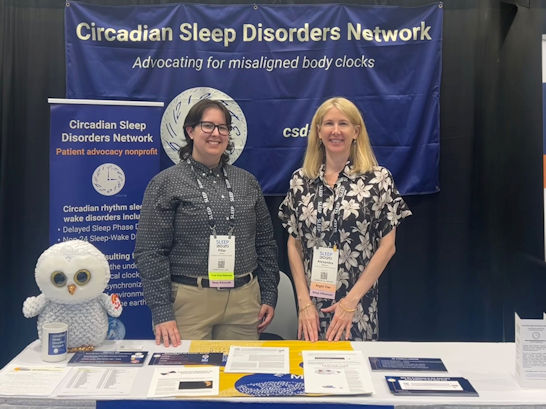
From June 8 to June 11, 2025, the APSS annual SLEEP conference was held in Seattle, Washington. CSD-N Executive Vice President Alex Wharton and Board Member Pillar Quinn attended the event and hosted CSD-N's booth, located in the Advocacy Pavilion of the exhibit hall.
Alex and Pillar answered questions and shared information about DSWPD and Non-24 patient experiences with the booth's steady stream of visitors (physicians, scientists, students and patients). The visitors offered ideas for improving CRD diagnosis such as biomarker testing, including melatonin and cortisol, and screening scales that inquire about chronotype, including the Pittsburgh Sleep Quality Index and Munich Chronotype Questionnaire. Alex highlighted circadian clock research studies in labs across the country and collaborated with fellow sleep disorder patient advocates about sharing resources and efforts.
Alex and Pillar also participated in a range of events and gatherings. Alex was CSD-N's representative at the AASM Patient Advocacy Roundtable in-person meeting, led by 2024 AASM President Dr. Eric Olson, and attended by several patient advocacy organizations including Project Sleep, Narcolepsy Network and Alliance of Sleep Apnea Partners.
Educational sessions they attended included: Circadian Rhythms and Their Impact on Health: From Genetic Variations to Metabolic Responses, co-chaired by Dr. Christopher Depner and Dr. Dayna Johnson, and Circadian Medicine: Centering Interventions Around Sleep or the Clock?, chaired by Dr. Saurabh Suhas Thosar.

Mar 2025
Project Sleep's Rising Voices leadership program trains people with sleep disorders to become effective advocates through authentic storytelling and public speaking. Graduates are equipped to share their stories with healthcare providers, universities, local communities, news outlets, blogs, and more, to help raise awareness and reduce stigma.
The 2025 Rising Voices training will take place *online* from June 15-July 20. Spots are limited—the application deadline is April 15th, 2025, at 12 midnight ET.
For details and application click here.

Jan 2025
The American Academy of Sleep Medicine has released a new position statement emphasizing the clinical significance of sleepiness and its impact on performance, health, mood, safety, and quality of life.
The position states that sleepiness is a critical patient-reported outcome that is associated with an increased risk for adverse health effects and diminished quality of life. The statement urges health care professionals, policymakers, and researchers to prioritize the evaluation, management, and treatment of sleepiness to improve public health.
Circadian Sleep Disorders Network is listed as an organization supporting their position statement.
Full article is here.
Full peer-reviewed paper is:
Heffron TM, Gurubhagavatula I, Trotti LM, et al, Clinical significance of sleepiness: an American Academy of Sleep Medicine position statement, Journal of Clinical Sleep Medicine, AASM, 2025
Archived News 2024
Archived News 2023
Archived News 2022
Archived News 2021
Archived News 2020
Archived News 2019
Archived News 2018
Archived News 2017
Archived News 2016
Archived News 2015
Archived News 2014
Archived News 2013
Archived News 2011 - 2012 (incomplete)
